A facilities manager asks the cabling contractor which cable to pull. The contractor says “Cat6A, always.” The IT director looks at the quote, sees the premium, and says “Cat6 is fine.” Six years later, the company wants to run 10-gigabit to the server room and power Wi-Fi 6E access points at full PoE++, and suddenly the “fine” cable is not fine anymore.
Understanding the Cat6 vs Cat6A difference matters most at the moment of install, because ripping out horizontal cable to upgrade one category is almost never worth it. This guide covers what actually separates the two, where each one wins, and how to decide without overspending or underbuilding.
What Is The Difference Between Cat6 vs Cat6A – Quick Answer
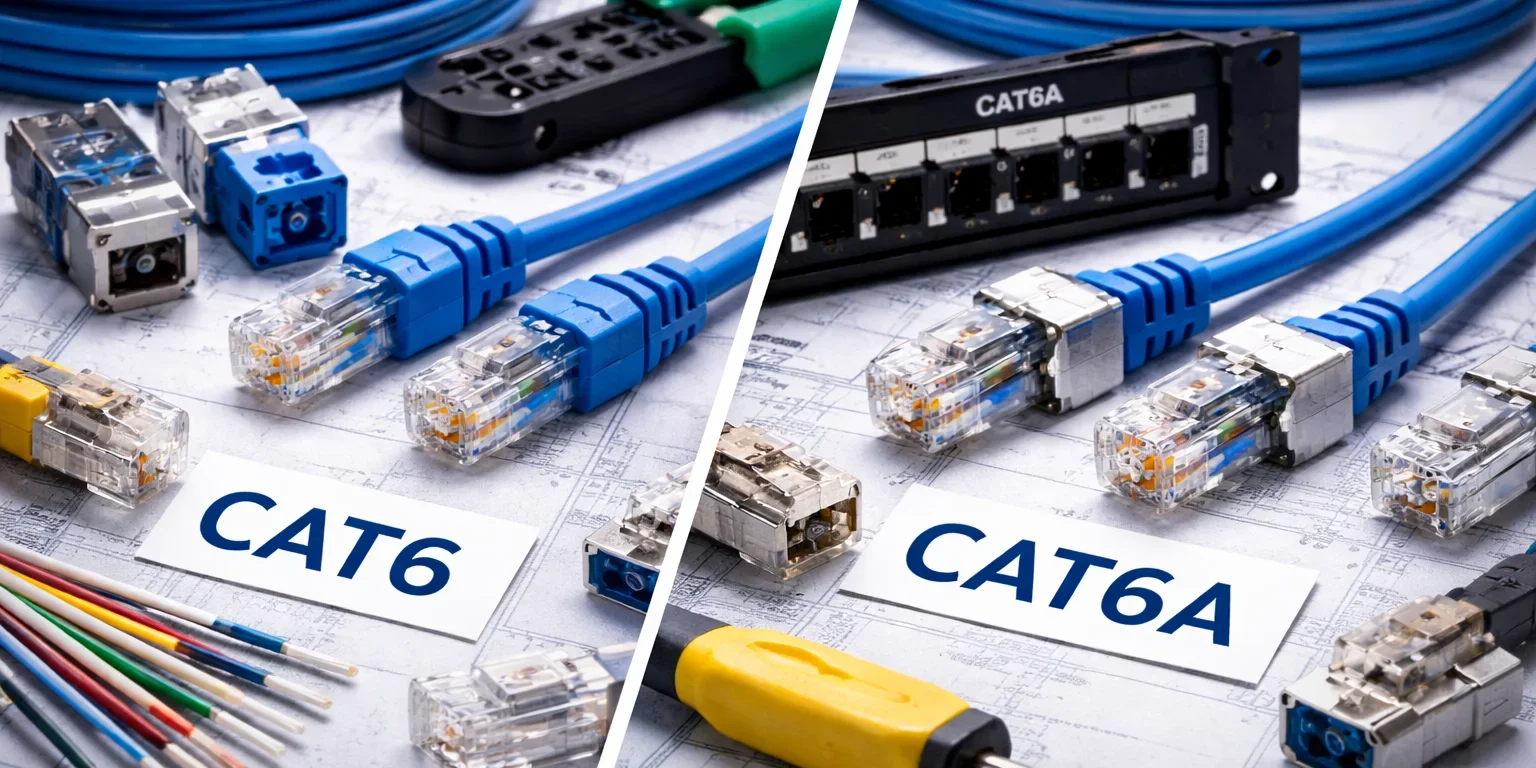
The Cat6 vs Cat6A difference comes down to 10-Gigabit performance and distance. Cat6 supports 10Gbps only up to 55 meters, while Cat6A supports the full 100-meter channel length for 10GBASE-T. Additionally, Cat6A has 500MHz bandwidth (double Cat6), handles PoE++ (up to 100W) heat loads better, and offers superior shielding against electromagnetic interference (EMI).
The Core Specifications Side by Side
Five technical differences separate these two categories, and each one has real consequences for how the cable performs in a working building.
| Specification | Cat6 | Cat6A |
| Maximum bandwidth | 250 MHz | 500 MHz |
| 1-gigabit ethernet | 100 meters | 100 meters |
| 10-gigabit ethernet | 55 meters | 100 meters |
| PoE+ (802.3at, 30W) | Supported | Supported |
| PoE++ (802.3bt, 60W/90W) | Supported but runs hotter | Supported with better heat dissipation |
| Shielding | Usually unshielded (UTP) | Often shielded (F/UTP or U/FTP) |
| Cable diameter | Around 0.22 to 0.25 inches | Around 0.29 to 0.35 inches |
| Minimum bend radius | 1 inch | 1 inch, but stricter in practice |
| Typical cost per foot | $0.30 to $0.60 | $0.50 to $1.00 |
| Installed cost per drop | $150 to $250 | $200 to $300 |
The headline number is the 10-gigabit distance, and it drives almost every other decision.
What the 10-Gigabit Distance Gap Actually Means
A 55-meter 10GBASE-T limit on Cat6 sounds like plenty until you start measuring real buildings. The 55 meters has to cover the entire channel, which includes the horizontal run, the patch cord at the work area, and the patch cord in the telecom room. Real working horizontal runs often push past 55 meters in any office larger than about 8,000 square feet on a single floor.
Cat6A’s 100-meter 10-gigabit support matches the standard ANSI/TIA-568 channel limit. Any drop in the building can run 10 gigabit without a distance worry. For a business planning to upgrade switches and endpoints over the next decade, that headroom is the entire value proposition.
Why PoE Performance Differs
PoE+ at 30 watts works fine on both categories. The gap opens at PoE++ (802.3bt), which delivers up to 60 or 90 watts per port for devices like high-draw wireless access points, PTZ cameras, digital signage, and powered video conferencing displays.
Higher wattage means more heat in the cable bundle. Cat6A’s larger conductors and construction dissipate heat better than Cat6. In a cable bundle of 24 or more drops all running PoE++, Cat6 can see performance degradation from heat buildup, while Cat6A handles it cleanly. For any building planning to power Wi-Fi 6E or Wi-Fi 7 access points, which routinely pull 40 to 60 watts each, Cat6A is the safer choice.
Shielding and Interference
Cat6 is almost always an unshielded twisted pair (UTP). Cat6A is often shielded, either as F/UTP (foil around all four pairs) or U/FTP (foil around each individual pair). Shielding matters in electrically noisy environments: near elevator motors, industrial machinery, medical imaging equipment, or bundled high-voltage runs.
For most office environments, shielding is overkill. For warehouses with forklift charging stations, manufacturing floors, or medical suites with MRI and imaging equipment, the shielded Cat6A construction prevents the crosstalk and interference issues that would slow down an unshielded cable.
What Changes in the Install
Cat6A is not a drop-in replacement for Cat6. The physical cable is bigger, stiffer, and harder to pull.
The diameter difference (up to 40 percent larger) matters for conduit fill, cable tray capacity, and j-hook spacing. A conduit sized for 24 Cat6 drops may only fit 18 Cat6A drops under National Electrical Code fill rules. Bend radius is stricter because violating it on shielded Cat6A degrades performance more than on UTP Cat6.
Termination takes longer. Shielded Cat6A jacks require proper shield continuity and grounding, which adds minutes per termination. Field technicians need the right tools and training: a crew comfortable with Cat6 will slow down on their first shielded Cat6A job.
None of this makes Cat6A bad. It just means the per-drop cost difference reflects real labor and material differences, not just cable markup.
When Cat6 Still Makes Sense
Cat6 has not disappeared for a reason. There are genuine scenarios where it is the right choice.
Small commercial tenants with short leases, under 10 users, and no plan to run 10-gigabit ethernet within the lease term. The cost savings are real and the performance ceiling is not a limitation.
Buildings with very short horizontal runs. A compact office where no drop exceeds 40 meters can run 10 gigabit on Cat6 comfortably, though this is harder to guarantee than it sounds.
Budget-constrained projects with clear short-term scope. If the business is renovating a space for a 3-year lease and does not expect to upgrade beyond gigabit endpoints, Cat6 saves real money.
Secondary runs to low-priority devices. Some installs mix categories intentionally: Cat6A to workstations and APs, Cat6 to printers and low-bandwidth devices. This works if documented clearly.
When Cat6A Is Worth the Premium
Cat6A is the right call in most modern commercial scenarios. The decision gets easy in these cases.
New construction or major renovation where you are paying labor once. The material cost delta is small compared to the labor of pulling cable, and replacing horizontal cabling later is painful.
Any building meant to last ten or more years before the next major IT refresh. Cat6A handles the current generation of switches and has headroom for the next two.
Medical, financial, or data-center-grade installs where performance consistency and Fluke-certifiable margins matter more than the $30 to $75 per-drop premium.
Buildings with Wi-Fi 6E or Wi-Fi 7 in the plan. The access point PoE draw, bandwidth demand, and future upgrade path all favor Cat6A.
Multi-floor buildings where backbone fiber plus Cat6A horizontal runs create a clean, future-proof infrastructure with consistent performance across the entire site.
Decision Framework
Use this framework to decide quickly for a specific project.
| Scenario | Recommended Category |
| New commercial build, 10+ year horizon | Cat6A |
| Class A tower tenant buildout | Cat6A |
| Medical, dental, or healthcare office | Cat6A (shielded where EMI present) |
| Industrial or manufacturing facility | Cat6A shielded |
| Warehouse with PoE cameras and APs | Cat6A |
| Small tenant, short lease, budget priority | Cat6 |
| Renovation of space occupied under 3 years | Cat6 acceptable |
| Adding drops to existing Cat6 infrastructure | Match existing (usually Cat6) |
| Backbone or inter-rack runs | Fiber, not copper |
| Runs over 90 meters horizontal | Cat6A or fiber |
What We See Go Wrong
The most expensive mistake we see on commercial jobs is mixing categories without documentation. A building gets Cat6 in the original install, Cat6A added in a 2020 renovation, and Cat5e still in service for analog phones. Nothing is labeled, nobody tracks which category runs where, and every troubleshooting call turns into a tone-and-probe expedition.
The second mistake is specifying Cat6A cable but terminating it on Cat5e or Cat6 jacks because the electrician “had some in the truck.” A Cat6A system requires Cat6A cable, Cat6A jacks, Cat6A patch panels, and Cat6A patch cords end to end. Mixing components caps performance at the weakest link, which means the customer paid the Cat6A premium and got Cat6 performance.
The third mistake is pulling Cat6 through conduit designed for it, then trying to add more runs later and realizing there is no room for Cat6A’s larger diameter. Always size pathway for the category you might install next, not the one you are installing today.
Field Note: West Loop Tech Office Buildout
A 40-person software company takes a converted warehouse space in the West Loop. The IT director asks whether Cat6 is acceptable to save $4,000 across the project.
Walking the space, the longest horizontal run measures 78 meters from the proposed IDF to the farthest workstation. On Cat6, that run would support gigabit fine today but would fail 10GBASE-T cold (well past the 55 meter limit). The company also planned to deploy Wi-Fi 6E access points in 18 months, each pulling 40 to 50 watts over PoE++.
The $4,000 saved would have locked the building into gigabit at the desk and forced a full rewire when the Wi-Fi 6E refresh happened. Cat6A went in. Three years later, the firm upgraded the core switch, turned on 10-gigabit uplinks to the server rack, and the horizontal cabling did not need a single change.
What It Costs the Build
The per-drop premium for Cat6A over Cat6 runs $30 to $75 in most commercial markets, driven by material cost, slightly slower termination, and the larger pathway space requirement. On a 50-drop install, that is roughly $1,500 to $3,750 extra.
The material cost alone is around $0.20 to $0.40 more per foot. On 50 drops averaging 60 feet each (3,000 feet total), material adds $600 to $1,200. Labor and jack cost make up the rest of the premium.
Compared to the cost of rerunning cable in a live building five years later (easily $250 to $400 per drop with occupied-space premiums), the upfront Cat6A cost looks like cheap insurance.
Still Deciding? We Design Cat6 and Cat6A Systems for Chicago Businesses
Chicago Network Solutions designs and installs both Cat6 and Cat6A systems across Chicago-area commercial buildings, with Fluke certification and TIA-606 documentation on every install.
Whether the project calls for a full Cat6 cabling installation, a structured cabling buildout with Cat6A throughout, fiber optic backbone between floors, or commercial ethernet wiring, the specification gets matched to the building, the lease term, and the long-term technology roadmap.
If your building is in Chicago, call (312) 818-3517 or contact us to schedule a site walkthrough.
FAQs
Is Cat6A actually faster than Cat6?
Both support 10-gigabit ethernet. The difference is distance: Cat6 runs 10 gigabit only up to 55 meters, while Cat6A supports the full 100 meter channel length. For 1-gigabit links, both perform identically. Cat6A’s real advantage is future-proofing, not raw speed at short distances.
Can I mix Cat6 and Cat6A in the same building?
Yes, but document which runs are which. Many commercial buildings have mixed-category infrastructure from staged upgrades. The key is labeling per TIA-606 so future IT teams know what they have. Mixing without documentation creates endless troubleshooting problems.
Does Cat6A require shielded cable?
Not always. Cat6A comes in both unshielded (UTP) and shielded (F/UTP or U/FTP) variants. Shielded Cat6A is recommended for environments with significant electromagnetic interference: industrial facilities, medical imaging suites, or runs near high-voltage equipment. Standard office environments usually do fine with unshielded Cat6A.
Will Cat6 support Wi-Fi 6 access points?
Cat6 supports Wi-Fi 6 APs at standard PoE+ power levels (30 watts) and gigabit uplink speeds without issue. The concern arises with Wi-Fi 6E and Wi-Fi 7 access points that draw PoE++ (60 to 90 watts) and may benefit from multi-gigabit uplinks. For those, Cat6A provides better heat dissipation and distance flexibility.
Is Cat6A backward compatible with existing Cat6 equipment?
Yes. Cat6A jacks, patch panels, and patch cords all work with Cat6-rated switches and devices. The cable will simply run at the lower category’s performance level. This backward compatibility makes Cat6A safe to install even if current equipment does not need the full bandwidth.
How much more does Cat6A cost than Cat6 on a real project?
The installed per-drop premium typically runs $30 to $75 depending on pathway conditions, plenum rating, and whether shielded Cat6A is specified. On a typical 50-drop commercial project, expect to pay $1,500 to $3,750 more for Cat6A than Cat6 total.
When is it worth paying for Cat6A?
Any new install with a 10-year horizon, any building planning to run 10-gigabit ethernet, any deployment of Wi-Fi 6E or Wi-Fi 7, and any environment with significant PoE++ loads or electromagnetic interference. If the building is a short-term lease with no upgrade plans, Cat6 remains acceptable.
Closing Thought
The Cat6 vs Cat6A decision is not really about cable. It is about how long the business plans to live in the building and how much future upgrade headroom justifies the upfront premium. For most new commercial installs today, Cat6A is the right answer because labor costs dominate and the material delta is small relative to the value of never rewiring.
Before signing a cabling proposal, match the category to the actual use case: longest run length, PoE draw, expected equipment upgrades, and lease term. A Cat6A install specified correctly today will still be adequate in a decade. A Cat6 install specified incorrectly will force a rewire in three years.
Services covered in this guide
Chicago Network Solutions installs and supports every system described here across Chicago and the surrounding suburbs.
Service areas:Naperville · Schaumburg · Rosemont · Elk Grove Village · Des Plaines · Niles · Skokie · Evanston