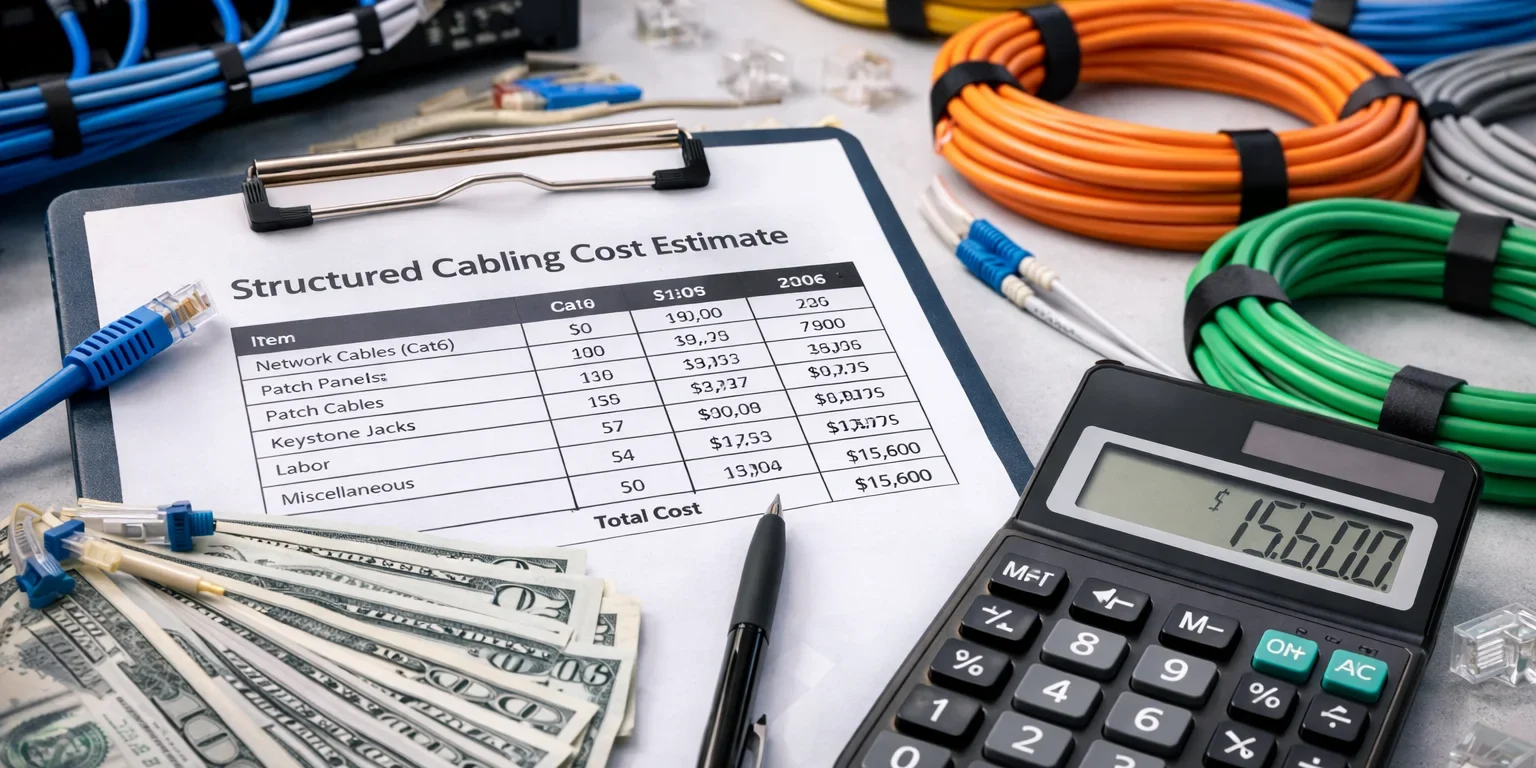
Important: Because every building has unique pathway challenges, ceiling types, and security requirements, a “per-drop” estimate is exactly that-an estimate. It is always wise to schedule a professional site walkthrough before finalizing your budget. An exact quote depends on a physical inspection of your specific space to identify hidden cost drivers like plenum requirements or difficult riser access.
Every cabling quote a business owner gets back looks wildly different, and the reason usually has nothing to do with the cable itself. One contractor quotes $125 per drop, another quotes $300, and the scope of work in both proposals looks identical on paper. The gap lives in everything around the cable: ceiling access, building age, testing requirements, and whether the contractor actually plans to label and document the work.
This guide breaks down what drives structured cabling cost per drop in real commercial installs, with honest ranges and the specific factors that move pricing up or down.
Structured Cabling Cost Estimate Per Drop – Short Answer
Structured cabling cost per drop typically runs $150 to $350 or more in commercial settings. Standard Cat6 office installs often land between $150 and $250 per drop, while Cat6A, plenum-rated, after-hours, or certification-heavy work climbs to $200 to $350+ per drop. Building age, ceiling access, pathway difficulty, and testing documentation drive most of the variation.
What a Drop Actually Includes
A “drop” in commercial cabling is one complete horizontal cable run from the patch panel in the telecom room to a single wall jack or device location. The per-drop price on a proposal should include materials (cable, jack, faceplate, patch panel port, patch cord), labor to pull and terminate the run, and testing to verify the drop meets its category specification under ANSI/TIA-568.
What usually gets quoted as “$150 per drop” and what actually shows up as a final invoice can differ sharply. Contractors who low-ball the per-drop number often exclude testing, documentation, after-hours labor, plenum-rated materials, or the mid-span pathway hardware that any real commercial install requires.
Price Ranges By Install Type
The per-drop number moves based on several independent factors. Here is how we see commercial pricing land across different install types.
| Install Scenario | Typical Range Per Drop | Primary Cost Drivers |
| New construction, Cat6, drop ceiling | $125 to $175 | Easy pathway, bulk labor efficiency |
| Existing office, Cat6, accessible ceiling | $150 to $250 | Moderate pathway work, some obstacles |
| Existing office, Cat6A, plenum-rated | $200 to $300 | Higher material cost, heavier cable |
| Older building, limited access | $250 to $400 | Pathway difficulty, walls may need opening |
| Occupied space, after-hours work | $200 to $350 | Premium labor, slower progress |
| Fiber run (multimode OM4) | $300 to $600+ | Specialty termination, testing equipment |
| Drop with Fluke certification testing | Add $25 to $50 | Testing time, documentation delivery |
| Drop with full TIA-606 labeling and as-built | Add $15 to $35 | Documentation labor |
These ranges are commercial ballparks. Residential and small-business point-to-point installs sometimes come in lower, but they rarely include the testing and documentation that real commercial work requires.
What Actually Drives Pricing Up
Cable and jack costs are a small part of the total. The labor side is where quotes diverge, and five factors explain most of the difference.
Building Age and Construction
Newer buildings with drop ceilings, accessible cable trays, and clean pathways let a two-person crew pull 30 to 50 drops a day. Older buildings, especially pre-war structures in the Loop or converted warehouses in the West Loop, cut that rate in half or worse. Solid masonry walls, plaster ceilings, limited riser access, and asbestos-era materials all slow the work and raise per-drop cost.
Ceiling and Pathway Access
Drop ceilings with 2×2 or 2×4 tiles are the easiest. Hard-lid ceilings, ductwork congestion, and plenum spaces full of existing services (HVAC, sprinkler pipe, other low-voltage) all add hours per drop. In some older buildings we have worked in, the ceiling is so full that a single drop takes three times the normal labor to route properly.
Cable Category and Material Grade
Cat6 is the baseline. Cat6A costs more per foot, is physically larger and heavier, requires larger conduit fill, and demands tighter bend-radius control. Plenum-rated cable (CMP) costs significantly more than riser-rated (CMR) and is required in any air-handling space. For a plenum Cat6A install, materials alone can add $40 to $60 per drop over riser-rated Cat6.
Testing and Certification Requirements
Basic continuity testing takes seconds per drop. Full Fluke certification testing (wire map, length, attenuation, NEXT, return loss, and more) takes a few minutes per drop and requires a $5,000 to $10,000 tester plus the technician’s time. Jobs that require Fluke certification reports for every drop, common in medical, financial, or data center installs, cost more per drop than jobs that do not.
Labor Conditions
After-hours and weekend work usually carries a 25 to 50 percent labor premium. Working in occupied spaces is slower than working in a shell building. Union labor requirements, common in some commercial buildings and large institutional projects, also move pricing compared to non-union shops.
What We See On-Site
The biggest per-drop cost surprise on real projects is almost always pathway. A building owner shows us a floor plan, we count 40 drops, we write a clean per-drop number, and then the site walk reveals that 15 of those drops require pulling through a plenum space already packed with other services, or through a corridor where the ceiling cannot be opened without landlord approval.
The cable itself might be $25 per drop in materials. The labor to get that cable from point A to point B in a difficult pathway can be $150 or more per drop. Anyone quoting commercial cabling without walking the site is guessing, and the guess usually favors the contractor on the change-order side.
Field Report: Cost Analysis of a Chicago Loop Office Install
A law firm takes 15,000 square feet on the 22nd floor of a Class A Loop tower built in 1987. They need 85 drops: workstations, conference rooms, printers, wireless APs, IP phones, and cameras. Landlord requires licensed low-voltage contractor, after-hours work only, plenum-rated cable, and Fluke certification reports delivered as part of closeout.
Here is how the per-drop cost builds up:
| Cost Component | Per-Drop Amount |
| Cat6A plenum cable and jack materials | $45 |
| Patch panel port, patch cord | $15 |
| Labor (after-hours rate, moderate access) | $140 |
| Fluke certification and report | $35 |
| TIA-606 labeling and documentation | $25 |
| Total per drop | $260 |
Total project: roughly $22,100 for the 85 drops, plus the separate costs of the MDF/IDF buildout, backbone fiber, rack and cable management hardware, and the switch gear itself. The per-drop number is real and honest, but it is only one line in a larger proposal.
What Lowers Per-Drop Cost
Three things consistently bring per-drop pricing down on commercial projects.
- Volume. A 200-drop install costs less per drop than a 20-drop install. Crews become more efficient, material gets bought in bulk, and fixed setup costs spread across more work.
- Pathway readiness. If cable trays, conduits, and pull strings are already in place from previous construction or a recent electrical rough-in, a cabling crew can move much faster.
- Timing. New construction or pre-occupancy work during normal business hours always beats retrofit work in an occupied space after hours.
What Raises Per-Drop Cost Without Warning
Watch for these on a proposal or during a site walk.
- Asbestos abatement requirements in older buildings can halt a job entirely or require specialty labor. Any building from before 1980 with original ceiling tiles or pipe insulation needs verification before cable work starts.
- Landlord requirements in Class A buildings often mandate specific installers, after-hours work, building engineer supervision, and detailed closeout documentation, all of which raise cost.
- Fire stopping requirements where cables penetrate rated walls or floors add real per-penetration cost that gets spread across affected drops.
- Change orders from unclear scope are the single biggest source of cost overruns. A proposal that does not specify cable category, jack count, testing level, and documentation deliverables almost guarantees a change-order conversation later.
Want a Real Per-Drop Quote? Chicago Walkthroughs Available
Chicago Network Solutions provides detailed per-drop pricing after a site walkthrough, with scope, testing level, and documentation deliverables written clearly into every proposal.
Whether the project calls for a full structured cabling installation, a specificCat6 cabling run, commercial ethernet wiring, or a broader network cabling project, the pricing reflects the real pathway and labor conditions of your building.
If your project is in the Chicago area, call (312) 818-3517 or contact us to schedule a site walkthrough.
FAQs
Is structured cabling priced per drop or per foot?
Commercial cabling is almost always priced per drop in proposals, because drops are what the end user actually counts. Behind the scenes, contractors estimate based on cable footage, labor hours, and materials, but the unit presented to the customer is the drop. Some very long fiber runs or backbone work get priced per foot separately.
Does the per-drop price include the switch port or end device?
No. A drop covers the cable, jack, patch panel port, patch cord, and testing. Switches, wireless access points, VoIP phones, cameras, and workstations are all separate line items. A quote showing $200 per drop does not include the $400 switch that drop connects to.
Why do cabling quotes for the same building vary so much?
Pricing is rarely about the cable itself; it’s about the “Environmental Difficulty.” In dense city centers like the Chicago Loop or Manhattan, older buildings often have solid masonry walls, plenum ceilings packed with HVAC, and strict landlord mandates for after-hours work.
A suspiciously low quote usually means the contractor is cutting corners on:
- Pathway Hardware: Skipping J-hooks or cable trays.
- Material Grade: Using Riser-rated cable where Plenum is legally required.
- Testing: Only doing basic continuity checks instead of full Fluke certification.
- Documentation: Not providing a TIA-606-C as-built map.
Tip: Always compare the Scope of Work (SOW) line-by-line. A $150 drop with no testing is actually more expensive in the long run than a $250 certified and documented drop.
Do I need Fluke certification testing on every drop?
For business-critical installs, medical facilities, or anything that will carry 10GBASE-T on Cat6A, yes. Full Fluke certification catches termination problems that basic continuity testing misses. For lower-stakes installs, basic testing plus spot-check certification is often enough. Expect to pay $25 to $50 extra per drop for full certification with a delivered report.
How much does Cat6A cost versus Cat6 per drop?
Cat6A typically adds $30 to $75 per drop over Cat6, depending on whether plenum rating is required, pathway constraints, and total project size. The material itself is heavier and larger, so labor time per drop also rises slightly. For most commercial installs that need to last ten-plus years or support 10 gigabit ethernet, the cost difference is worth it.
Can I reduce per-drop cost by using cheaper cable?
Reducing the cable category below Cat6 is a false economy. Cat5e is effectively obsolete for new commercial installs. The labor to pull and terminate is the same or higher for cheap cable, so material savings are small while performance ceiling drops significantly. Reduce drop count or phase the project before reducing cable category.
Do cabling contractors charge more for after-hours or weekend work?
Yes. Typically, you can expect a 25% to 50% labor premium for work performed outside of standard business hours (8 AM – 5 PM).
In major metropolitan areas, many Class A office towers and high-density commercial buildings mandate that all “noisy” or disruptive work (like drilling or pulling cable through ceilings) must happen after-hours to avoid disturbing other tenants.
Pro-Tip: If your building has these restrictions, ensure the premium is listed as a transparent line item in the proposal. If a contractor’s “per-drop” price seems unusually high, ask if they’ve already baked in the after-hours labor costs.
Closing Thought
Structured cabling cost per drop is a useful planning number, but it is not the whole proposal. The real question is what is included at that price: cable category, testing, labeling, pathway hardware, and after-hours provisions.
Before accepting any cabling quote, walk the site with the contractor and get the scope in writing, line by line. A $175 per-drop proposal with everything included is cheaper than a $125 proposal that turns into $250 per drop once change orders start.
Services covered in this guide
Chicago Network Solutions installs and supports every system described here across Chicago and the surrounding suburbs.
Service areas:Naperville · Schaumburg · Rosemont · Elk Grove Village · Des Plaines · Niles · Skokie · Evanston