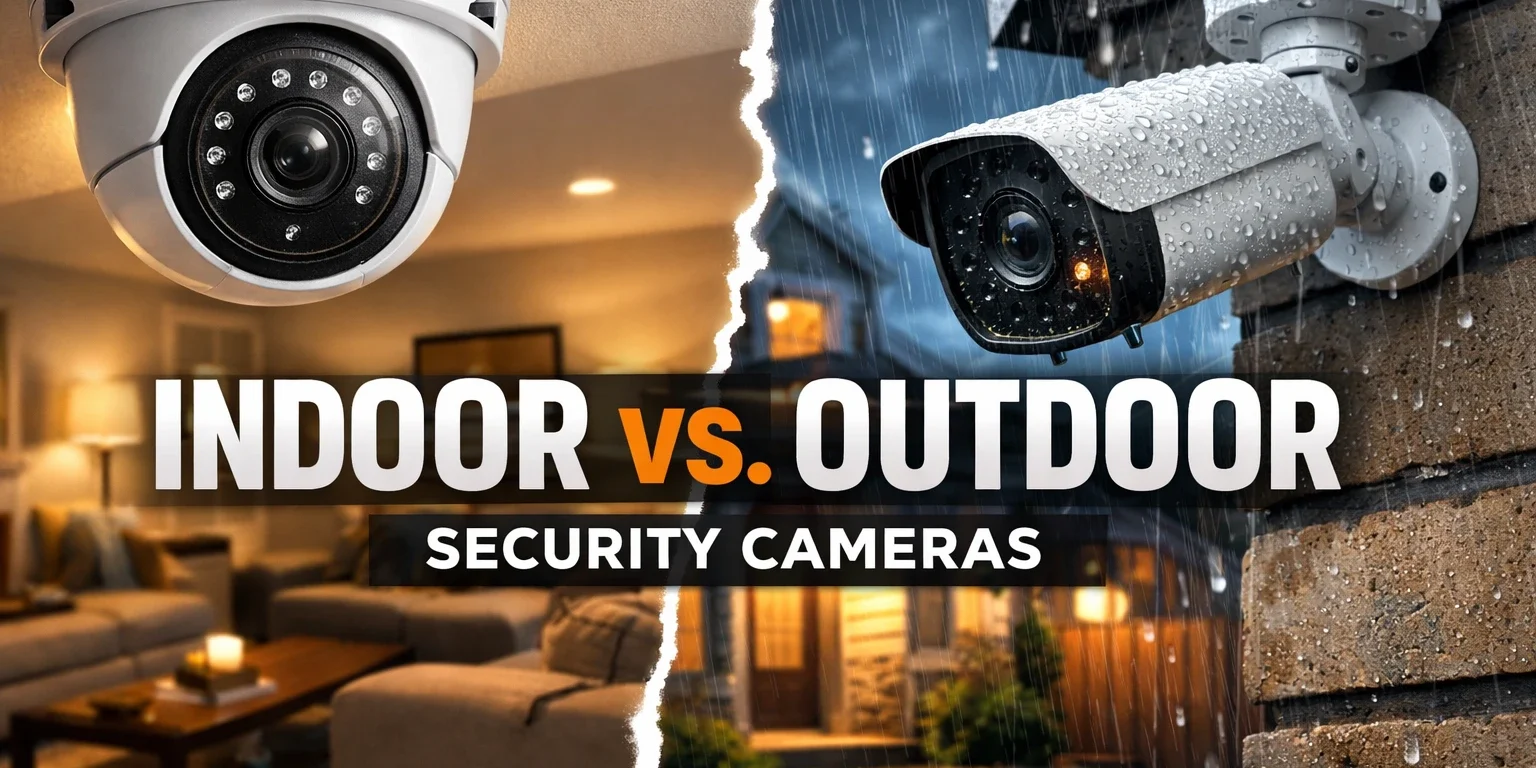
Many businesses know they need security cameras, but the real confusion often starts with camera type. A camera that works well inside an office may fail outside at an entry point, parking area, or rear door. On the other hand, a heavy-duty exterior camera may be unnecessary for a quiet hallway, office suite, or reception area.
That is why understanding Indoor vs Outdoor Security Cameras matters so much. The right choice is not just about where the camera sits. It affects image quality, durability, coverage, and how well the overall system performs. For business owners, office managers, property managers, and facility teams, that decision can shape how useful the system feels every day.
Indoor vs Outdoor Security Cameras: Quick Answer
Indoor vs Outdoor Security Cameras comes down to where the camera will be installed and what the space demands. Indoor cameras are designed for hallways, offices, lobbies, and common areas, while outdoor cameras are built to handle weather, temperature changes, and wider perimeter coverage.
As we often explain to clients, the right camera type improves image quality, durability, and overall system performance. A business that matches each camera to the actual environment usually gets better coverage, fewer maintenance issues, and a stronger long-term result.
Why the Difference Between Indoor and Outdoor Security Cameras Matters
A camera is only useful if it fits the space where it is installed. Businesses sometimes assume one camera type can work everywhere, but that often leads to weaker footage, poor durability, or avoidable replacement costs. The difference between indoor and outdoor cameras matters because each one is built for a different job.
When the wrong type is used, performance suffers. An indoor camera placed outside may struggle with weather, glare, or changing light conditions. An outdoor camera placed inside may still work, but it may be bulkier, more expensive, or less practical than what the space really needs. That is why camera planning should always begin with environment, not assumptions.
Camera placement affects performance
The environment shapes what a camera needs to do. A hallway camera usually deals with controlled lighting, stable temperatures, and a more predictable field of view. A camera at an exterior door or parking area faces sunlight, rain, darkness, wind, and wider open coverage.
That difference affects image quality and reliability. A business that plans camera placement properly usually gets clearer footage, better durability, and fewer blind spots.
The right camera type supports the whole system
A camera system works best when each device suits its role. Businesses often need interior cameras for staff movement, common spaces, and reception areas, along with exterior cameras for entrances, perimeter views, and after-hours monitoring.
That layered approach creates a more complete setup. It also makes the overall commercial security systems in Chicago plan stronger because the cameras are chosen based on real use, not guesswork.
What Are Indoor Security Cameras Best For?
Indoor security cameras are designed for controlled interior spaces. They work well in hallways, reception areas, lobbies, waiting rooms, office suites, conference areas, shared corridors, and other common spaces where lighting and weather are less of a concern.
These cameras often focus on interior visibility, staff movement, visitor flow, and event review. Their job is usually to help the business monitor activity inside the property with consistent image quality and practical placement.
Best indoor camera locations
Indoor cameras usually work best in spaces where the business needs visibility into normal activity. That may include reception desks, office entrances, shared hallways, open work areas, stairwells, and storage corridors.
These are the areas where businesses often want a clear record of movement without having to deal with harsh outdoor conditions. For many offices, indoor coverage supports both safety and day-to-day accountability.
Why indoor cameras are useful for office environments
Office buildings often need interior visibility more than people first realize. A front entrance camera may show who came in, but interior cameras help show where people went, how shared spaces were used, and what happened after someone entered the property.
That is one reason indoor cameras often play an important role in security camera installation in Chicago for office buildings. They help reduce blind spots inside the property and support stronger incident review if questions come up later.
What Are Outdoor Security Cameras Best For?
Outdoor security cameras are built for tougher conditions and wider coverage. They are designed for exterior walls, building entrances, rear doors, parking lots, loading zones, perimeter lines, and other areas exposed to weather, changing light, and broader security risks.
Their job is not only to record what happens outside. They also help businesses see problems earlier, especially at entry points and after hours. This makes them one of the most important parts of perimeter protection.
Best outdoor camera locations
Outdoor cameras usually work best at main entrances, side doors, rear access points, parking areas, alley-facing exits, service entrances, loading zones, gates, and other places where people can enter or move around the property from outside.
These areas often create the highest security exposure, especially after hours. Strong exterior camera placement helps businesses monitor what happens before someone ever reaches the inside of the building.
Why outdoor cameras matter for perimeter security
Many businesses focus first on interior coverage, but exterior visibility often matters just as much. If a camera system cannot show who approached the building, which door they used, or what happened outside before an incident, the review may stay incomplete.
That is why outdoor cameras often form the first layer of visibility in a broader security setup. They support entry-point awareness, perimeter monitoring, and stronger after-hours review.
Indoor vs Outdoor Security Cameras: Main Differences
The biggest difference between indoor and outdoor cameras is not appearance. It is how they are built to perform in different environments. Indoor cameras focus on stable interior conditions, while outdoor cameras are designed for exposure, durability, and broader visibility.
The better the match between camera type and environment, the better the result. That improves not only image quality, but also maintenance, system lifespan, and overall reliability.
Weather resistance and durability
Outdoor cameras are built to handle rain, wind, dust, temperature changes, and other environmental stress. That makes them better suited for exterior doors, parking areas, loading zones, and perimeter coverage.
Indoor cameras are not usually built for that type of exposure. They are designed for cleaner, more controlled spaces, which helps keep them lighter and more suitable for office interiors.
Field of view and coverage goals
Indoor cameras often monitor more focused areas such as hallways, office entrances, or waiting areas. Outdoor cameras may need to capture wider views that include door approaches, vehicle movement, or broader perimeter zones.
That difference affects how each camera is selected and placed. A narrow hallway and a parking lot do not ask for the same type of coverage.
Lighting conditions
Interior lighting is usually more stable and predictable. Exterior lighting changes throughout the day and can become much more difficult at night. Outdoor cameras often need to perform in bright sun, shadow, darkness, or direct exposure from headlights or nearby lighting.
That makes camera choice especially important. A business that wants strong outdoor footage should think carefully about how lighting changes across the day and after hours.
Mounting and housing needs
Outdoor cameras usually require stronger mounting and more protective housing because they face more exposure. Indoor cameras can often use simpler mounting solutions because the environment is more controlled.
This may seem like a smaller detail, but it affects installation quality and long-term performance. A camera should not only capture the right view. It should also stay secure and stable where it is installed.
A Simple Indoor vs Outdoor Security Cameras Comparison Table
The table below shows the main differences in a simple format.
| Camera Type | Best For | Main Strength | Main Limitation |
| Indoor Security Cameras | Hallways, offices, lobbies, common areas | Better suited to controlled indoor spaces | Not built for rain, weather, or major temperature changes |
| Outdoor Security Cameras | Entrances, parking lots, rear doors, perimeter areas | Stronger durability and better exterior coverage | May be more than needed for simple indoor spaces |
Together, these camera types help businesses create a stronger system when each one is placed where it performs best.
Which Camera Type Is Better for Entry Points?
Entry points often need the most careful camera planning because they sit at the boundary between inside and outside. A business may need to see who approached the building, who entered, and what happened immediately after entry. That usually means one camera type alone is not enough.
In many cases, the best solution is to use outdoor cameras for the approach and exterior door area, then indoor cameras for the reception space, lobby, or hallway just inside the entrance. That gives the business a clearer picture of the full movement path.
Main entrance planning
A front door is one of the most important areas to secure. An outdoor camera can help capture approach activity and exterior access, while an indoor camera can show what happened once someone entered.
That two-layer approach often improves both security and review. It gives managers better visibility without forcing one camera to do everything.
Side and rear doors
Side and rear doors often create more risk than the front entrance because they receive less attention. These areas usually benefit from outdoor cameras because they are exposed to weather and often need stronger after-hours visibility.
If the door also leads to a staff corridor or back office area, an indoor camera just inside the entry may also make sense. That depends on the layout and how the space is used.
When Businesses Need Both Indoor and Outdoor Security Cameras
Most office buildings and commercial properties do not need to choose one or the other. They usually need both. Indoor and outdoor cameras serve different roles, and the strongest systems often use each type in the areas where it performs best.
A business that installs both types thoughtfully can improve visibility across entrances, shared areas, staff zones, and exterior risk points. That leads to a stronger and more practical security system overall.
Interior visibility plus exterior awareness
Outdoor cameras help the business see what happens before someone enters the building. Indoor cameras help show what happens once they are inside. Together, they reduce coverage gaps and improve incident review.
This is one reason many businesses move toward a broader commercial security systems in Chicago approach rather than thinking about cameras as separate one-off devices.
Better long-term system performance
Using the correct camera type in the correct place also helps the system perform better over time. Outdoor cameras are less likely to fail early when exposed to weather, and indoor cameras are less likely to be oversized for quiet office spaces.
That leads to better value, fewer avoidable problems, and a cleaner match between the system and the building.
How to Choose the Right Camera Type for Your Business
The best way to choose between indoor and outdoor cameras is to start with the building layout and the security goal for each area. Ask what needs to be seen, what conditions the camera will face, and whether the location is exposed to weather, changing light, or broader movement.
That review usually makes the right choice much clearer. It also helps prevent a common mistake: selecting cameras based only on appearance, general pricing, or assumptions about what “should work.”
Start with the environment
The first question should always be where the camera will be installed. If the location faces weather, wider exterior exposure, or larger perimeter coverage, an outdoor camera usually makes more sense. If the location is a controlled indoor space, an indoor camera is often the better fit.
This simple starting point prevents many avoidable errors. The environment should guide the decision before any brand, model, or extra feature is considered.
Match the camera to the coverage goal
A camera should also be chosen based on what the business wants to monitor. Some areas need focused hallway visibility. Others need wider door approach or parking-lot coverage. Those goals should shape the selection.
That is why planning matters so much in security camera installation in Chicago. Good placement and correct camera type usually make a bigger difference than buying a more expensive device without a clear purpose.
Common Mistakes Businesses Make With Indoor and Outdoor Cameras
One common mistake is installing indoor cameras outside because they seem cheaper or easier to place. Another is using outdoor cameras in every location without thinking about whether interior coverage needs something more practical and targeted.
Both mistakes can reduce system value. One weakens durability. The other can create unnecessary cost or awkward placement. A stronger plan matches each camera to its real job.
Using one camera type everywhere
Some businesses try to simplify the project by choosing one camera type for the whole property. That may feel easier at first, but it often ignores the real difference between office interiors and exposed exterior areas.
A better system uses indoor cameras where the environment is controlled and outdoor cameras where the property needs stronger protection against weather and wider visibility demands.
Focusing only on price instead of fit
Lower-priced cameras can be tempting, but the better question is whether the camera suits the space. A cheaper indoor camera that fails outside will not save money in the long run.
The right fit usually delivers better image quality, stronger durability, and a more reliable system over time. That matters much more than the lowest short-term price.
A Simple Example of Indoor and Outdoor Camera Planning
A small office may use an outdoor camera at the main front entrance, another at the rear access point, and indoor cameras in the lobby and hallway. That setup gives the business exterior awareness plus interior visibility without overcomplicating the system.
A larger office building may need more layers. It may use outdoor cameras at all major entrances, perimeter areas, and parking zones, while also using indoor cameras across shared entrances, common corridors, and sensitive office areas. The right mix depends on the property, but the principle stays the same: match the camera to the environment and the coverage goal.
Quick Checklist for Choosing Indoor vs Outdoor Security Cameras
Use this checklist when planning camera placement:
- decide whether the location is inside or exposed to weather
- identify whether the area needs focused or wider coverage
- review lighting conditions during day and night
- confirm whether the space is an entry point, hallway, parking area, or common area
- decide whether one location needs both interior and exterior visibility
- make sure camera type matches the actual environment
- plan the system around the building, not just around equipment lists
This simple checklist can help businesses avoid weak placement and improve overall system performance.
FAQs
What is the main difference between indoor and outdoor security cameras?
The main difference is where they are built to perform. Indoor cameras are designed for controlled interior spaces, while outdoor cameras are made for weather exposure, changing light, and broader exterior coverage.
That difference affects durability, image quality, and long-term performance.
Can indoor security cameras be used outside?
In most cases, that is not the best choice. Indoor cameras are not usually designed for rain, dust, temperature swings, or other outdoor conditions.
Even if one works for a short time, it may not hold up well over the long term.
Can outdoor security cameras be used inside?
Yes, they can be used inside, but that does not always make them the best fit. An outdoor camera may be bulkier or more advanced than what a simple hallway or office interior really needs.
The better choice usually depends on the environment and the coverage goal, not just whether the camera can technically function there.
Do businesses usually need both indoor and outdoor security cameras?
Yes, many businesses do. Outdoor cameras help monitor entrances, perimeter areas, and parking zones, while indoor cameras help cover hallways, offices, lobbies, and common areas.
Together, they provide broader visibility and a more complete security system.
Which camera type is best for office hallways and lobbies?
Indoor cameras are usually the better fit for hallways, lobbies, reception areas, and common interior spaces because they are designed for controlled environments and focused interior monitoring.
They help businesses improve visibility inside the property without overbuilding the setup.
Which camera type is best for parking lots and exterior doors?
Outdoor cameras are usually best for parking areas, exterior doors, rear entries, and perimeter coverage because they are built for weather exposure and wider outdoor monitoring.
These locations often need stronger durability and more flexible exterior performance.
How do I choose the right camera type for my building?
Start with the environment, then review the coverage goal. Ask whether the space is indoors or outdoors, what lighting conditions look like, and what type of visibility the business needs.
That process usually makes the right camera choice much clearer.
What is the biggest mistake businesses make with camera selection?
One of the biggest mistakes is choosing camera type without thinking about the actual environment. That often leads to poor durability, weak placement, or unnecessary cost.
A stronger system comes from matching each camera to the job it needs to do.
Need Help Planning the Right Camera Setup in Chicago?
Chicago Network Solutions helps businesses choose the right camera type based on building layout, entry points, coverage needs, and long-term system performance. Whether you need security camera installation in Chicago, access control systems in Chicago, or a broader commercial security systems in Chicago plan, we can help you build the right mix for your property. Call us at (312) 818-3517 or visit our Contact Us page to discuss your building.
Conclusion
The answer to Indoor vs Outdoor Security Cameras is not about which one is better overall. It is about which one fits the space. Indoor cameras work best in controlled areas such as hallways, offices, lobbies, and common spaces. Outdoor cameras are built for weather, changing light, and wider perimeter coverage.
The strongest business security systems usually use both in the right places. When camera type matches the environment and the coverage goal, the result is better image quality, better durability, and a more reliable system over time.